Sunday, November 6, 2011

You’ve got to have grist before you can grind.

My writing has recently stalled. The problem is this: nearly all of it has been in 30-60-minute chunks at the ends of long tiring days. These writing sessions have been conducted entirely without a plan and their only purpose has been to sustain my writing streak.

Prior to the current rut, I used a combination of short sessions and all-day and all-night writing binges to edit/polish a couple major projects and send them off to their respective judges. I do not yet know the fate of my papers, but they are out of my hands and there is no reason to edit them any more at this time. So, my writing efforts must return to longer-term projects, particularly the first three chapters of my dissertation.

The problem is that in order to write anything more on these chapters, I need to invest significant time in library research and puzzling through confusing statistical concepts. This cannot be done in half an hour. Even 2 hours is really not enough—it takes me that long just to figure out what books I should look at!

It’s a bit like when Saruman’s emissaries tore down the old mill in Hobbiton and replaced it with a bigger, louder, more modern mill, “full o’wheels and outlandish contraptions”. As Farmer Cotton explained to Merry Brandybuck, “you’ve got to have grist before you can grind, and there was no more for the new mill to do than the old”. I have a great new writing habit (amazingly, it really has become a habit!), but it doesn’t do me any good unless I have something to write about.

I need to dedicate some long sessions, 4+ hours, to non-writing research activity, something I have so far rarely done in a normal work week. I have done it (and liked it!) during breaks between semesters, when I don’t have work responsibilities and know I can catch up on sleep afterwards. So, I need to either trick myself into thinking I’m on vacation, or figure out a way to fit it into my normal schedule (using the words “normal” and “schedule” rather loosely).

So, next weekend must include several hours of deciphering statistics books and working problems. If I don’t find some grist soon, I might as well tear down my wonderful new writing model and replace it with a garden, as the hobbits did with the smoking new mill. Hmmmm…..a peaceful garden sounds rather nice. No, don’t even think about it—in this case, the new model really is better than the old. This hobbit just needs to get to work!

Friday, October 28, 2011

The Streak Reaches 100

Yes, it’s official: Last night, for the 100th day in a row, I spent 30 consecutive minutes writing my paper. Earlier this summer, I finally decided to actually try the “write every day” advice I have heard so often, and 83 days ago I created a written writing streak definition so I wouldn’t be tempted to cheat.

I must confess that, while I haven’t technically cheated by claiming false information in my writing log, there were many nights when my heart wasn’t in it, I was too tired to put coherent sentences together, or my attention was distracted. During tonight’s writing session, for example, I wrote through a splitting headache while simultaneously watching the Rangers try as many ways as possible to give away what should have been their World Series victory game. It could be argued that these writing sessions are of questionable value. Runners have a name for this: “junk miles”. Junk miles are miles run for no other training purpose except to add a number to the running log. Runners are not in agreement about this--some think junk miles should be avoided, while others think all miles have value and there are no such things as junk miles.

What about my “junk writing minutes”? Are they valuable, or are they a way to deceive myself about my writing progress? Undoubtedly, I should put some thought into improving the way I manage my sleep, work, and life, so that I can give quality undistracted minutes to my writing. Realistically, if I wait until I have time and energy to reorganize my life so I can write every day, it will never happen. If I only write on the days I have time to write well, I will never write. Theoretically, my life contains some days with enough time to write well and other days without, and I should be able to write on the good days. The trouble is, if I don’t write on the bad days, I won’t think of it on the good days. Even if I do think of writing on the good days, I won’t know what to write because I won’t have looked at my paper for a week or more. The “write every day” plan accomplishes one very important objective: It keeps me from hiding from my dissertation. Since I am not allowed to hide from it, I am almost forced to make forward progress, even if slow.

Key to my streak has been my Excel spreadsheet writing log, which calculates the length of the streak and prevents me from cheating. I found it easiest to put together formulas in two different cells to do calculate the streak, instead of doing it all in one.


In cell G180:
=IF(ISBLANK($D180),"",IF(F180<30,"NO","YES"))

In cell A180:
=IF(ISBLANK(D180),"",IF(AND(B180-B179=1,G180="YES",G179="YES"),A179+1,IF(B180-B179=0,A179,1)))

Have I occasionally been tempted to skip a day? Yes. Why haven’t I? I knew I would regret it the next day. Also, I am scared of the consequences of letting the “write every day” habit end. If I quit, I may go back to what I was for far too long: a grad student who was making no progress (due to hiding from the dissertation) but who was unable to fully experience everyday joys of life (due to the guilt of the unprogressing dissertation). You can avoid working on the dissertation, but you can’t get rid of it except by finishing it. Even if you are hiding from it very effectively and haven’t looked at it in a year, you still must carry it everywhere you go, and it is heavy. Imagine carrying an invisible backpack full of invisible rocks everywhere you go. It really takes the fun out of life!

How long will I keep up the writing streak? I don’t know. I have occasionally thought it would be neat to keep it going until the day I graduate (so yes, years from now), but we’ll see. I think the primary reason for continuing so far is that once I started, I wanted it to end on my terms. Cal Ripken didn’t end his streak of 2632 consecutive games by getting injured or by becoming such a bad player that the Orioles didn’t want him to play. He ended it by voluntarily removing his name from the lineup for the last home game of 1998. I’d prefer to do the same.

Until then, let the junk writing go on!

Saturday, October 15, 2011

Racing with performance-enhancing drugs: Steroids really work!

Ten days ago, I finally made it to an allergist, in hopes of finding out why my nose had been running on and off the last year (pretty much nonstop “on” all summer). I spent two and a half hours there, exactly the same amount of time I spent at the Department of Public Safety office in June when my driver’s license was up for renewal. During my stay at the allergist’s office, I received 3 different breathing tests, a CT scan of my head, a starter set of skin tests, two conversations with a medical doctor, and a detailed explanation of how to use/take medications and inhalers. All my tests were conducted by friendly, efficient, and competent technicians. My two and a half hours at the driver’s license office, on the other hand, included 25 minutes reading a research article, two hours of the Spider Solitaire app on my NookColor and a 5-minute consultation and eye test, conducted by a somewhat friendly, but not necessarily efficient, government employee.

I left the allergist with a list of eight separate diagnoses, including various types of rhinitis and sinusitis, sinus polyps, and asthma. Apparently there’s a rip-roaring infection in every cavity in my head, and all the places that were supposed to be black on the CT scan were actually a mucky shade of gray. The allergist gave me a short lecture, rebuking me for not coming in much earlier and expressing hope that the mess could be cleared with drugs and that surgery would not be needed. Just the mention of that ominous possibility was enough to make me enthusiastically embrace the drugs, no questions asked. Instead of dinking around for a few days, perhaps reading up on side effects, hoping that maybe it would clear up on its own, and wondering whether the highly trained doctor was over-prescribing, I immediately filled all of the prescriptions and started taking everything exactly on schedule. I had already received my starter dose of steroids—the doctor’s office had given me the first dose while I was there, because they did not want any delay.

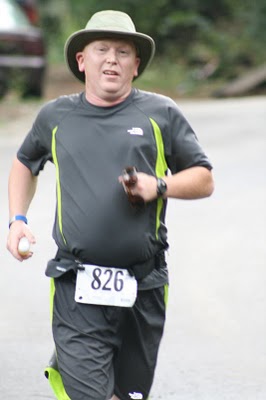
The day after the doctor’s visit, I felt absolutely terrible, and was very happy I was giving tests because I don’t think I could have made it through an actual class. This was the first day I had really felt sick. The second day after the doctor’s visit, I felt a hundred times better, and I could finally breathe through that same nose that had not felt real airflow in a month. It was amazing!! The third day after the doctor’s visit, I ran a 10-mile race, the 10 for Texas in The Woodlands.

I ran this race last year, and had signed up for this year’s race quite some time ago. This week I had second thoughts, and briefly considered skipping it, especially when I felt so awful two days before. But no, I had already paid my money, and I didn’t want to end up with a race shirt that I would always feel funny wearing because I hadn’t actually run the race. I would do the race, but would keep my expectations realistic, and be content with going a little slower than I did last year. After all, I have only run about once a week for the last 6 weeks, and I haven’t done a double-digit run since August. (The Winslow Half-Marathon doesn’t count as a double-digit mileage run, because I walked up all the hills, meaning I walked almost as much as I ran.) So I was definitely undertrained, but was confident I would survive, even if it wasn’t especially fun.

On race morning, I showed up early hoping to beat the traffic and also exchange my race shirt for a smaller one (mission accomplished!). After seeing breaks in the predicted clouds, I had second thoughts about leaving my sunglasses in the car, and I returned for them. Outside the parking garage, wonder of wonders, I ran into my sweet friend Mary Beth, there to watch and cheer on her husband Fred. This had to be a divine appointment, as there were two thousand runners, plus accompanying spectators and volunteers, and there was no way I could have expected to find someone I knew.

We visited for a while, took some photos, and settled Mary Beth into a chair near the finish line. In the Winslow race, my brother Dave Mows Grass utilized the strategy of finding a 64-year old woman to pace him the first few miles. Since this worked so well for Dave, I decided to try something similar. But I improved the strategy by 19 years, running the first couple of miles with my 83-year old friend Fred, the oldest runner in the race.

We kept a leisurely pace, drinking in that special sort of camaraderie that is unique to the beginning of a running race. Everyone, even the slowest back-of-the-pack runner, seems to pick up on race-day excitement, and until that excitement starts to mix with tiredness, which will happen a little while later, feels strong and powerful, and very glad to be out running a race instead of at home in bed, or shopping, or cleaning the house, or all the other mundane bits of life that the rest of the world does on a weekend morning.

After a couple miles, I felt stronger than I expected, so I said farewell to Fred and moved on ahead. I ran a couple of miles with someone who I discovered had finished less than a minute before me last year, and she recalled that last year, it was much cooler, in the fifties. It was still overcast, but getting warmer and would soon become a hot, muggy day. We chatted about how, especially with the heat, and for me also the sinus infection and total lack of recent running, we both expected to be a little slower this year. But somehow, in spite of all these difficulties, I felt pretty good, so I left my new friend, assuming she would catch up with me when I flaked out the last mile or two of the race.

I didn’t chat long with anyone else, but just kept going. Somehow I kept steadily passing person after person, and only a very few people passed me the rest of the race. I noticed, not for the first time, an odd optical illusion. Nearly all the first half of the race seemed to be a slight downhill, which was fine and in fact very enjoyable, but I knew that what goes down must come up, and I fully expected the last half of the race to be a corresponding uphill. Fortunately, this did not turn out to be the case. The second half of the race was also nearly all downhill, all the way back to our starting point.

Surprisingly, I didn’t become really miserable until after mile 8, and even when I felt wiped out and was tempted to walk, I somehow kept running. I finished in 1:45:21, four minutes faster than last year. How on earth did I do this? Why did the whole race feel downhill, even though it began and ended at the same location? Why was I able to pass twenty times more people than passed me? Why was I able to run faster in heat and humidity than I did last year, in twenty degrees cooler, perfect running weather? How was I able to overcome my total lack of training?

Was it because I was well-rested? Well, resting a few days or a week might have been good, but I seriously doubt if resting for 6 weeks would improve running performance. Was it because of the training effect of the Winslow hills? Dave said that running Winslow without Hammer Gel was like climbing Everest without oxygen, so maybe there could be something there. Wait, it turns out I have asthma…wow, I guess I did run Winslow without oxygen! But hiking up some Winslow hills once couldn’t possibly cause me to be able to run 10 hot flat concrete miles at a 10:32 pace, faster than slowpoke me has ever done in my life.

No, there can be only one possible explanation: the STEROIDS!! After only 3 doses, the steroids not only knocked down the sinus infection, but gave me the ability to run faster than ever before. It’s amazing, really. Unfortunately, at least running-wise, my steroid regimen ends tomorrow, so I will soon be back to my usual slow self.

I am so glad I decided to run the 10 for Texas, and not just because of my steroid-induced personal record. I was happy for Fred that he managed to sneak in with a time just under 2 hours—I know he was pleased with his run. It was an absolute joy to spend the morning with Fred and Mary Beth. I am so grateful to have such friends, who remind me that this life is only temporary, and that the most important things are eternal. Fred had his shirt made before his first marathon. It says “The Hope of Glory” on the back (this mystery is described in Colossians 1:27).

I realize that running is just a hobby, and that while it is perhaps a healthier activity than some other hobbies, there is nothing especially meritorious about it. But there’s something about running a race that reminds me just how much I have to be grateful for. Not just the ability to run, but every breath is a gift that should be cherished.

What a special morning.

Sunday, October 2, 2011

Musings on the writing model: Fear of commitment

My wonderful writing professor, without whose advice I would have made far less progress on my dissertation, cautions me not to binge-write. She argues for a writing model in which I schedule a writing session every day, and protect that writing session as an important appointment. At the end of each writing session, I am to plan the next writing session. None of these planned writing sessions should last more than a couple of hours. If the day’s schedule allows, I could schedule multiple sessions with breaks between them.

I’m sure this is a marvelous model and that those who follow it are very productive writers. I certainly have no credibility to argue against it, as I am a terribly unproductive writer. I confess I have never followed this model, so can produce no evidence that the model doesn’t work.

When my professor first told me about this approach to writing, I completely agreed with it and decided to do exactly what she said. Excited about my new plan, I dutifully scheduled, or at least intended to schedule, my next few days of writing sessions. Unfortunately, my good intentions did not suffice to overcome my natural selfishness and tendency toward laziness, and I did not follow through on my commitments. The primary problem was not so much that I did not protect my writing appointments, but rather that I did not make the appointments at all.

When I look deep inside myself and examine my character, I find that among many flaws resides a strong sense of honor and honesty, and that I place a high value upon the keeping of promises. On the surface, this sounds like a good thing, and in some ways it is. Unfortunately, it is mixed with a large amount of pride, and too often I concern myself more with the keeping of a promise than about whatever or whoever caused me to make the promise in the first place. In other words, I sometimes keep promises with my hands but not my heart.

I realize I am explaining this very badly…..and what does this have to do with my writing? The problem is that I much prefer to be a promise-keeper than a promise-breaker. I do not enjoy the feeling of shame that comes with failing to keep a commitment. Therefore I tend to only make commitments I can keep without too much trouble. So instead of making an actual writing appointment, complete with start and end time, and either keeping or breaking it, I have attempted to accomplish the same thing by trying to summon up warm feelings and enthusiasm toward writing, and a general sense of dedication toward making progress.

Is it possible to finish my dissertation or become a productive writer with this approach? Will I grow up, change my ways and actually schedule, on paper, with an exact start time, my daily writing sessions? Will I learn that the most important commitments are those that require pain to keep? Will I be willing to set high standards, and accept the risk that I may fail to meet them?

I simply do not know. I am not sure whether scheduling my writing appointments would improve the writing rhythm I seem to have recently developed, or disrupt it. In the words of Gimli the dwarf, “Sworn word may strengthen quaking heart.” The wisdom of Elrond responded, “Or break it.” So, I will follow Elrond’s advice and go on my journey with a good heart, not looking too far ahead and trusting that a blessing rests upon my endeavors. Surely I will muddle through somehow.

The original title of this post was “What is the Optimal Proportion of Binge Writing?” I planned to argue that my professor’s writing model could be improved by supplementing the daily writing sessions with regular binge-writing sessions, in which I write nearly all day, or all night, or both, or maybe even for most of a weekend. But I have discovered that once I start writing about something, it takes on a life of its own and wanders off to unexpected places, and sometimes it is simply impossible to regain control. Maybe that’s okay—according to my brother Dave Mows Grass, good blog posts are supposed take a sound point and turn it into a rambling screed. That has certainly happened here. Since this weekend is scheduled (well, if not scheduled, at least intended) to be a weekend of binge writing, then maybe next week I will be better equipped to either defend or denounce the addition of binge writing to the productive writing model.

Sunday, September 25, 2011

Winslow Half-Marathon: You don’t need a good time to have a good time

Yes, I did it…I survived the Winslow Half-Marathon, without running a single hill in training. My brother Dave Mows Grass talked me into this—it was to be his first half-marathon, actually his first running race of any sort, and he was willing to let me share in the fun. Thanks to Winslow, I dragged myself out to run four times a week through Houston’s hottest summer on record. Of course, none of those runs involved any hills, so I knew I was totally unprepared for Winslow.

I’d heard from Dave that Arkansas had shared in the summer heat wave that had fried Texas and Oklahoma. I’m sure most runners were hoping for a nice cool day, but I, rather unwisely, wanted a really hot one! I knew that heat and humidity would work to my advantage. If the temperature at the start would have been 70°F, rising to 85°F by 10:30, the results of this race could have been very different. All those Arkansas hill-runners would have been completely disabled by the heat, forced to walk up hills they would have normally sprinted, while I, acclimated to running in a very humid 95-98°F, would have zipped right by them (at least on the downhills), exclaiming, “Wow, what a beautiful day! I love Arkansas weather!” But alas, it was not to be. Driving through Oklahoma the day before the race, the temperature dropped, and dropped, and kept dropping into the 50’s. I realized I had not brought a jacket, or even a long-sleeved T-shirt, with me. So I popped my freezing self into a small-town Wallyworld and splurged on a nice warm OU Sooner shirt. I like it!

It rained all the day before, and quite a bit during the drive to Winslow, but cleared up nicely, or so it seemed. Upon arrival, we dutifully obeyed the friendly race volunteer who directed us to park in the high school’s only handicapped space. (As promised, we did not get a ticket.) Winslow is a neat little town, allegedly the highest incorporated point in Arkansas, and occupies an area of 1.9 very steep square miles.

Knowing my complete lack of readiness for the hills, I implemented my planned strategy of running down the hills and walking up the steepest parts. Nearly everyone passed me during the first mile, but I checked my watch and knew I shouldn’t try to go any faster. I passed some of them later. After 5 miles or so, I was pretty happy with my 11:30 pace, and knew if I could keep it up, I’d be very happy with my race. I was alone much of the time, since there were only 126 runners, far fewer than any other race I’ve done, but it was a nice friendly sort of solitude. All went pretty well until mile 6 or so, when we encountered a long muddy downhill that was so slippery no one without superhuman coordination could run it. I carefully picked my way down the hill, and ran most of the way to the halfway-point turnaround. Just as I began to climb back up the slick muddy hill, the skies let loose. It poured, and thundered, and we were all soaked, muddy and freezing. I was actually pretty happy I had passed the turnaround when the rain came—it was much less discouraging that way. Fortunately, the rain let up after a mile or so, and except for that one hill, the dirt road was runnable—not terribly slick or muddy.

Of course, after poking slowly up and down the big muddy hill, slowing on the other downhills due to iffy footing from the rain, and my flat-trained legs running out of zip, my 11:30 pace was long gone. Though my time expectations had never been high, it had now morphed from a race to a fun run in my mind, and I just couldn’t seem to muster up the motivation to push myself very hard. I looked at the scenery, said hi to the friendly pit bull in the middle of the road, and visited with my neighbors. I ran with someone recovering from an ultra, someone from El Paso trying to run a HM in every state, and with a nice lady named Marj. When I told Marj I was from Houston, she said, “Oh, you must be Dave’s sister—so nice to meet you!” I asked if she was in the kayaking club (all Dave’s other running friends were kayakers). Marj looked very confused and said that no, she had just met Dave during the race. Apparently they had run a few miles together early on, but she has that magic sort of personality that remembers people and their stories and instantly treats them as friends.

I had seen Dave shortly before I reached the turnaround—he was probably a half-mile ahead of me then, and looking good. I could tell he was having a great time. I was having fun too, but doing a bunch more walking than I expected. I was still running down all the hills, and bits of the uphills, but it was slow going. I was looking forward to the last mile—I knew it would be a long steep downhill into Winslow. And sure enough, it was glorious fun running down that hill!! I went just as fast as my tired legs would go, and I passed 3 people going down it…they hollered at me to be careful, but it seemed safer to just lean forward and run than to lean back and brake. I pretended I was on a roller coaster and threw my arms into the air. Neat!

With a race experience like this, who cares about finish times? Mine was the slowest yet, slower than the Austin half-marathon I completed 8 months after I started running. I thought at the time that Austin had hills—now I know better. Austin hills are nothing compared to Winslow. At least Austin was paved and had some long flat stretches. Dave finished about 12 minutes ahead of me, and I’m sure will beat me by an hour next year, thanks to a bunch of natural talent and hours of trail running on hills. The winner finished in 1:18, blazing fast in my book. The amazing thing is that when we saw him coming back after the turnaround, he was smiling and waving, encouraging us back-of-the-packers with a cheerful “Looking good! Keep it up!”, and appeared to be having a great time. I’ve never seen a race winner do that before—they are usually pushing themselves way too hard to say anything or even notice the rest of us. The second-place guy, quite a bit behind him, seemed to be in a lot more pain.

Maybe I should have pushed myself to the point of pain and finished a few minutes faster. Maybe I should have spent my summer getting up at 4:00 a.m. to run up parking garages. Maybe it’s silly to spend a weekend driving across three states and back to do a slow fun run. Or, maybe the exact right thing to do was to concentrate my summer’s time and energy on training for a longer and more difficult endeavor than Winslow (yes, the ever-hanging-over-my-head dissertation). And then maybe the next exact right thing to do was to lay the dissertation proposal aside for a week to share Winslow with my brother.

Wow, what a fun race!

P.S. I didn’t lay the writing/research completely aside. I am happy to say that my 30-minutes-per-day writing streak is still going—it reached 60 days on the night before the Winslow race!