My wonderful writing professor, without whose advice I would have made far less progress on my dissertation, cautions me not to binge-write. She argues for a writing model in which I schedule a writing session every day, and protect that writing session as an important appointment. At the end of each writing session, I am to plan the next writing session. None of these planned writing sessions should last more than a couple of hours. If the day’s schedule allows, I could schedule multiple sessions with breaks between them.
I’m sure this is a marvelous model and that those who follow it are very productive writers. I certainly have no credibility to argue against it, as I am a terribly unproductive writer. I confess I have never followed this model, so can produce no evidence that the model doesn’t work.
When my professor first told me about this approach to writing, I completely agreed with it and decided to do exactly what she said. Excited about my new plan, I dutifully scheduled, or at least intended to schedule, my next few days of writing sessions. Unfortunately, my good intentions did not suffice to overcome my natural selfishness and tendency toward laziness, and I did not follow through on my commitments. The primary problem was not so much that I did not protect my writing appointments, but rather that I did not make the appointments at all.
When I look deep inside myself and examine my character, I find that among many flaws resides a strong sense of honor and honesty, and that I place a high value upon the keeping of promises. On the surface, this sounds like a good thing, and in some ways it is. Unfortunately, it is mixed with a large amount of pride, and too often I concern myself more with the keeping of a promise than about whatever or whoever caused me to make the promise in the first place. In other words, I sometimes keep promises with my hands but not my heart.
I realize I am explaining this very badly…..and what does this have to do with my writing? The problem is that I much prefer to be a promise-keeper than a promise-breaker. I do not enjoy the feeling of shame that comes with failing to keep a commitment. Therefore I tend to only make commitments I can keep without too much trouble. So instead of making an actual writing appointment, complete with start and end time, and either keeping or breaking it, I have attempted to accomplish the same thing by trying to summon up warm feelings and enthusiasm toward writing, and a general sense of dedication toward making progress.
Is it possible to finish my dissertation or become a productive writer with this approach? Will I grow up, change my ways and actually schedule, on paper, with an exact start time, my daily writing sessions? Will I learn that the most important commitments are those that require pain to keep? Will I be willing to set high standards, and accept the risk that I may fail to meet them?
I simply do not know. I am not sure whether scheduling my writing appointments would improve the writing rhythm I seem to have recently developed, or disrupt it. In the words of Gimli the dwarf, “Sworn word may strengthen quaking heart.” The wisdom of Elrond responded, “Or break it.” So, I will follow Elrond’s advice and go on my journey with a good heart, not looking too far ahead and trusting that a blessing rests upon my endeavors. Surely I will muddle through somehow.
The original title of this post was “What is the Optimal Proportion of Binge Writing?” I planned to argue that my professor’s writing model could be improved by supplementing the daily writing sessions with regular binge-writing sessions, in which I write nearly all day, or all night, or both, or maybe even for most of a weekend. But I have discovered that once I start writing about something, it takes on a life of its own and wanders off to unexpected places, and sometimes it is simply impossible to regain control. Maybe that’s okay—according to my brother Dave Mows Grass, good blog posts are supposed take a sound point and turn it into a rambling screed. That has certainly happened here. Since this weekend is scheduled (well, if not scheduled, at least intended) to be a weekend of binge writing, then maybe next week I will be better equipped to either defend or denounce the addition of binge writing to the productive writing model.
Sunday, October 2, 2011


Sunday, September 25, 2011
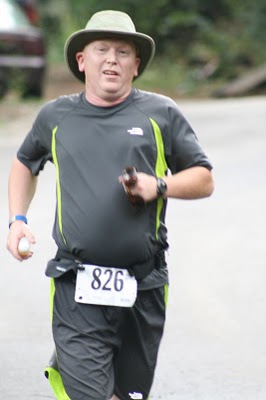
Winslow Half-Marathon: You don’t need a good time to have a good time
Yes, I did it…I survived the Winslow Half-Marathon, without running a single hill in training. My brother Dave Mows Grass talked me into this—it was to be his first half-marathon, actually his first running race of any sort, and he was willing to let me share in the fun. Thanks to Winslow, I dragged myself out to run four times a week through Houston’s hottest summer on record. Of course, none of those runs involved any hills, so I knew I was totally unprepared for Winslow.
I’d heard from Dave that Arkansas had shared in the summer heat wave that had fried Texas and Oklahoma. I’m sure most runners were hoping for a nice cool day, but I, rather unwisely, wanted a really hot one! I knew that heat and humidity would work to my advantage. If the temperature at the start would have been 70°F, rising to 85°F by 10:30, the results of this race could have been very different. All those Arkansas hill-runners would have been completely disabled by the heat, forced to walk up hills they would have normally sprinted, while I, acclimated to running in a very humid 95-98°F, would have zipped right by them (at least on the downhills), exclaiming, “Wow, what a beautiful day! I love Arkansas weather!” But alas, it was not to be. Driving through Oklahoma the day before the race, the temperature dropped, and dropped, and kept dropping into the 50’s. I realized I had not brought a jacket, or even a long-sleeved T-shirt, with me. So I popped my freezing self into a small-town Wallyworld and splurged on a nice warm OU Sooner shirt. I like it!
It rained all the day before, and quite a bit during the drive to Winslow, but cleared up nicely, or so it seemed. Upon arrival, we dutifully obeyed the friendly race volunteer who directed us to park in the high school’s only handicapped space. (As promised, we did not get a ticket.) Winslow is a neat little town, allegedly the highest incorporated point in Arkansas, and occupies an area of 1.9 very steep square miles.
Knowing my complete lack of readiness for the hills, I implemented my planned strategy of running down the hills and walking up the steepest parts. Nearly everyone passed me during the first mile, but I checked my watch and knew I shouldn’t try to go any faster. I passed some of them later. After 5 miles or so, I was pretty happy with my 11:30 pace, and knew if I could keep it up, I’d be very happy with my race. I was alone much of the time, since there were only 126 runners, far fewer than any other race I’ve done, but it was a nice friendly sort of solitude. All went pretty well until mile 6 or so, when we encountered a long muddy downhill that was so slippery no one without superhuman coordination could run it. I carefully picked my way down the hill, and ran most of the way to the halfway-point turnaround. Just as I began to climb back up the slick muddy hill, the skies let loose. It poured, and thundered, and we were all soaked, muddy and freezing. I was actually pretty happy I had passed the turnaround when the rain came—it was much less discouraging that way. Fortunately, the rain let up after a mile or so, and except for that one hill, the dirt road was runnable—not terribly slick or muddy.
Of course, after poking slowly up and down the big muddy hill, slowing on the other downhills due to iffy footing from the rain, and my flat-trained legs running out of zip, my 11:30 pace was long gone. Though my time expectations had never been high, it had now morphed from a race to a fun run in my mind, and I just couldn’t seem to muster up the motivation to push myself very hard. I looked at the scenery, said hi to the friendly pit bull in the middle of the road, and visited with my neighbors. I ran with someone recovering from an ultra, someone from El Paso trying to run a HM in every state, and with a nice lady named Marj. When I told Marj I was from Houston, she said, “Oh, you must be Dave’s sister—so nice to meet you!” I asked if she was in the kayaking club (all Dave’s other running friends were kayakers). Marj looked very confused and said that no, she had just met Dave during the race. Apparently they had run a few miles together early on, but she has that magic sort of personality that remembers people and their stories and instantly treats them as friends.
I had seen Dave shortly before I reached the turnaround—he was probably a half-mile ahead of me then, and looking good. I could tell he was having a great time. I was having fun too, but doing a bunch more walking than I expected. I was still running down all the hills, and bits of the uphills, but it was slow going. I was looking forward to the last mile—I knew it would be a long steep downhill into Winslow. And sure enough, it was glorious fun running down that hill!! I went just as fast as my tired legs would go, and I passed 3 people going down it…they hollered at me to be careful, but it seemed safer to just lean forward and run than to lean back and brake. I pretended I was on a roller coaster and threw my arms into the air. Neat!
With a race experience like this, who cares about finish times? Mine was the slowest yet, slower than the Austin half-marathon I completed 8 months after I started running. I thought at the time that Austin had hills—now I know better. Austin hills are nothing compared to Winslow. At least Austin was paved and had some long flat stretches. Dave finished about 12 minutes ahead of me, and I’m sure will beat me by an hour next year, thanks to a bunch of natural talent and hours of trail running on hills. The winner finished in 1:18, blazing fast in my book. The amazing thing is that when we saw him coming back after the turnaround, he was smiling and waving, encouraging us back-of-the-packers with a cheerful “Looking good! Keep it up!”, and appeared to be having a great time. I’ve never seen a race winner do that before—they are usually pushing themselves way too hard to say anything or even notice the rest of us. The second-place guy, quite a bit behind him, seemed to be in a lot more pain.
Maybe I should have pushed myself to the point of pain and finished a few minutes faster. Maybe I should have spent my summer getting up at 4:00 a.m. to run up parking garages. Maybe it’s silly to spend a weekend driving across three states and back to do a slow fun run. Or, maybe the exact right thing to do was to concentrate my summer’s time and energy on training for a longer and more difficult endeavor than Winslow (yes, the ever-hanging-over-my-head dissertation). And then maybe the next exact right thing to do was to lay the dissertation proposal aside for a week to share Winslow with my brother.
Wow, what a fun race!
P.S. I didn’t lay the writing/research completely aside. I am happy to say that my 30-minutes-per-day writing streak is still going—it reached 60 days on the night before the Winslow race!



Tuesday, September 13, 2011
My half-marathon strategy is like my dissertation strategy: Start slow and just keep on rollin’…
So, the Winslow Run with the Squirrels Half-Marathon is coming up in 5 days. I haven’t run in over a week, and I don’t anticipate finding time to run in the next few days, so I should be ready and rested.
Mile 1 of HM: From the elevation profile, it’s a one mile-long hill (UP-hill of course). It appears there may be a slight downhill at the start, probably designed to encourage the participants to begin the race by running. Photos of a crowd of people walking, or better yet, trudging, across the start line may not be ideal publicity for next year’s race.
My plan: Run through the start line, pretending it’s a race and pretending I’m a runner, and then walk the rest of the first mile. Why spend valuable energy running up a hill when I still have to do over 12 more miles?
Year 1 of PhD: Start the program running, with great enthusiasm, taking 3 classes my first summer and enrolling in another 3 for fall. Then slow to a walk/trudge/crawl, and be obligated to beg one of my professors for an incomplete so I could write my paper over Christmas and still fulfill my residency requirement.
Miles 2-6 of HM: These appear to contain rolling hills, which means every uphill stretch has a corresponding downhill stretch (if you’re a glass-half-full type of runner). If you’re a more negative personality, every glorious downhill is followed by a miserable uphill.
My plan: Run the down the hills and let my momentum carry me as far up the next hill as possible. Then walk the rest of the way up, trying to convince myself I am participating in a nature hike and not a race. If there are any race-related signs or other paraphernalia, look the other direction so I won’t feel guilty about not running.
Years 2-7 of PhD: (Yeah, I know, the year numbers don’t quite match the miles…if you think you can do better, go to grad school and show me!) Try to accumulate momentum during occasional breaks in the teaching and life schedule, and keep that momentum going as long as possible. When momentum dies, try to pretend that it doesn’t matter and that I am just a normal human being going about the normal responsibilities of life. If any reminders of the looming dissertation (which doesn’t yet exist but needs to) appear, hide quickly!! Any activity, from hobbies to housecleaning to sleeping, can serve as an excellent hiding place.
Mile 6-6.5 of HM: Enjoy this long, magnificent downhill and go as fast as I can!! Banish from my mind all thoughts about how it will feel to plod back up it after the turnaround.
Years 7-7.4 of PhD: Write like crazy through the entire summer when I’m not teaching. Actually feel like I am getting somewhere and that I just might finish this thing!
Mile 6.5-7 of HM: Go back up the exact same hill I ran down during Mile 6-6.5. Enough said. Ugh.
Year 7.5-8 of PhD: Attempt to do the same amount of writing I did this summer, but add a full-time teaching job. This is called “writing uphill”. Writing uphill is difficult, but contains occasional moments of fun, or at least novelty. No other experience can quite duplicate the sensations felt upon seeing the sun rise after an entire all-night writing binge.
Mile 7.5-12.5 of HM: Same hills as Miles 2-6, run the other direction, with the same strategy. If I missed any beautiful scenery the first time due to my tremendous downhill speed, I can enjoy the same scenes at my leisurely uphill walking pace. Maybe I’ll see some familiar squirrels!
Mile 12.5-13.1 of HM: All downhill to the finish!!
Years 8-??? of PhD: To be decided. I’m afraid my dissertation journey now diverges from the Winslow Run. I sure hope I don’t have to write up those same hills again!!
Saturday, September 3, 2011
At last: I defeated the produce!
Last fall, I was blessed with the opportunity to join an absolutely wonderful organization: a produce co-op. My friend Becky, who runs it, calls it a coop and calls us all coopers in her messages, but some part of me just cringes at the thought of being in a coop. So I have decided that if I am going to live in a coop, the coop must have a hyphen.
Every other Monday (coopday), Becky gathers all the money that her coopers have given her since the previous coopday, and she drives her van to a farmer’s market. I have never gone with her, so I’m not sure exactly what she does, but somehow she uses the power of the cash-filled envelope to negotiate bargains on large boxes of fruits and vegetables. When her produce-filled van returns home, she divides all the produce into boxes, one for each of us. I am curious to know her exact process for doing this—presumably the produce is in boxes when it enters her van (surely it’s not rolling around loose!), and it is in boxes when we eventually pick it up from her house. But when it enters her van, I expect that each box is full of like things (one box of apples, another box of peppers, etc.). When we get it, the box is full of unlike things (4 apples, 3 peppers, 1 cantaloupe, etc.). In order to refill the boxes properly, wouldn’t she have to empty them? Does she remove all the produce and lay it on the living room floor, and then distribute the apples among the boxes, the same number for each box? If I tried something like that, I would end up finding a 6-month old peach under my couch whenever I eventually vacuumed. It’s not a pleasant thought. Anyway, she must have a system for these details, because we each end up with a giant box, filled to the top with a huge variety of fruits and veggies.
For each co-op week, each cooper contributes $20. Being a bit of a data geek, I usually weigh my box as soon as I get home. My box weights have varied between 24 and 29 pounds. What an amazing deal!! Can you go to a store and buy any sort of food for less than $1 a pound?!? Spaghetti noodles, perhaps, but not produce! I am far from being an expert produce shopper, but some of things, such as red and orange bell peppers, are pretty expensive when purchased in a store. Of course, for most of the things, I have no idea whether they are expensive or cheap, because I have never bought them before.
My box has contained many fruits/veggies that not only had I never bought before, but I had no clue what they were. For example, I had eaten dried mangos before (thanks to a sweet sister who sent them to me from the Philippines!), but I had no idea what an actual whole mango looked like. Fortunately, Becky (aware of my status as a produce rookie) pointed out the mango the first time we received one. The mango is a very strange fruit! I still don’t know the proper way to cut it, and I don’t understand the shape of its core or how to tell the core from the yummy mango part, so I just keep cutting slices until I feel my knife encounter something hard and raspy, and then I cut somewhere else. We’ve had plenty of other mystery fruits, including a “cactus fruit” which had a bunch of hard seeds interspersed throughout the sweet parts. That one was more trouble than it was worth, but it was interesting. Kiwis are much nicer.
Since last Christmas, one of my recurring non-writing life goals has been to actually use up (or freeze or give away) the entire produce co-op box before any of it rots. Until last co-op, I had failed miserably in my attempts to attain this goal. I kept persisting, partly because I’m stubborn and hard-headed, but mostly because I am a terrible planner and decision-maker. The produce co-op removed the entire burden of grocery decision-making from my shoulders, a wonderful freedom. I am trying to write a dissertation after all, so I need to minimize non-research-related strains on my mental energy. I no longer had to decide what to buy, or to plan what day to do a grocery trip—when the produce co-op arrived, my only food-related goal was to use it up. Simple goals are good. Just as with my writing, even in the midst of my failures, I could still see improvement. As the months went by, a smaller percentage of the produce went bad.
Two produce co-ops ago, I really thought I was going to make it. I used all the salad stuff, froze a few things, and persuaded my hubby to eat some apples (Scott has many wonderful strengths, but consuming produce is not one of them). That was the first time my box had contained an eggplant, so I looked up eggplant recipes and really planned to do something with it. Unfortunately, it was final exam time, and life got crazy, and the eggplant defeated me. It got mushy and gross, and I had to throw it away without even cutting it open. I still have no idea what the inside of an eggplant looks like.
Finally, the next co-op after the eggplant rotted, I did it!! I actually finished all the produce before it died. (Well, there are a few things that got frozen, and there are still a couple of potatoes left, but they stay good for quite some time—so I still say I won.) Also thanks to the co-op, I enjoyed the satisfaction of another first: I actually used up a bottle of salad dressing! This had never happened before. Every other time I bought salad dressing, the salad dressing purchase coincided with a short burst of salad-buying inspiration. I would make the initial salad, use some dressing, and then put the remaining dressing in the fridge. About a year later, about how long it usually took for salad inspiration to strike again, I would examine the expiration date on the dressing, throw it away, and buy another bottle. Thanks to the produce co-op, I have now polished off two bottles of salad dressing before they expired.
One key to my victory was that I actually ate the squash. Many times, the co-op box has contained squash, and I’ve never had any idea what to do with it. I would let it intimidate me into complete paralysis, hiding it in the fridge drawer hoping for inspiration, which of course never came. When the next co-op arrived, I would open the produce drawer, discover that the nice firm squashes were now mushified, throw them away, and replace them with new fresh squashes. Until this recent co-op victory, the only squash I had ever cut up was a long green one that I thought was a cucumber. (I still didn’t know what to do with it, so most of it got thrown away, but at least I cut it up.) I still haven’t cooked a squash, but this time I cut them up and ate them raw—they’re actually pretty good!
Of course, I didn’t have much time to enjoy my triumph before the current batch of produce arrived. It came on the very first day of fall semester classes, and so far the only thing I have cut up is the celery. I haven’t frozen, cut, or washed anything else. The fridge is stuffed with cantaloupe, red bell peppers, corn, grapes, strawberries, cucumbers/zucchinis/green squash (not sure which), spinach, apples, peaches, carrots, broccoli, mango, tomatoes, kiwis, and some mysterious round green fruits that feel like plums but are the wrong color. My great victory may be followed by my worst defeat yet. I did give away a couple bananas to a colleague, and that’s about it. But I am ready for battle, armed with a 3-day weekend, my Forever Sharp knife, Ninja blender and salad spinner. Let the duel begin!!
Tuesday, August 30, 2011
Research: It needs to be an Hourly job
As I see it, there are 3 main ways that jobs can pay money: by the Hour, by the Task, and Salaried. I should note that some Salaried jobs are really Hourly jobs in disguise…if you are required to keep track of the hours you work, or make up for time you missed, then it’s an Hourly job. If you get paid overtime for working extra, it’s an Hourly job. Since working on a dissertation doesn’t pay money (it actually costs money), I am allowed to choose whether I want to think of it as Hourly, by-the-Task or Salaried.
By-the-Task sounds like a good idea, but since I have yet to finish a single dissertation-related Task, I am not optimistic about this approach. Even if I break down the big Tasks into small pieces that can theoretically be done in a day, I know that frequently they will take much longer than I expect (everything does!), and I will give up in despair. If I can’t even finish my single Task of the day, why should I work on research at all?
Thinking of the dissertation as a Salaried job is an even worse idea. With a Salaried job, all I have to do is pretend to work. I’m neither required to complete certain Tasks, nor work a fixed number of Hours. So I could potentially pretend to work on my dissertation for years at a time, continuing to receive my paycheck (remember, it’s negative!), without ever getting any closer to my degree. I must confess that I have done this at times, sometimes for long stretches, but it is definitely a bad plan.
My only hope is to think of my dissertation as an Hourly job, one that requires me to work a certain number of hours each day or week. If I can’t do the scheduled hours one day, I need to make them up later that week. (I think this is called comp time, but I’m not sure, since I have almost no experience with Hourly full-time jobs.) If my paying job were an Hourly job, I would be very motivated to work the required number of hours, because I would know that if did not do so, I would get fired.
Unfortunately, the Hourly research job does not pay money, which means I will have to trick myself into meeting the Hourly requirements. I also (fortunately or unfortunately, not sure which) am unlikely to get fired from the Hourly research job, at least not for a couple more years when I reach the 10-year limit on doctoral studies. Texas A&M would be silly to fire me, as I am a reliable source of income for the university. I cheerfully pay my tuition each semester, while utilizing a very small portion of the resources which my fees support. I am probably a net taker when it comes to the Library Use Fee ($26.45), and perhaps eventually the University Writing Center Fee ($8), but I am definitely a net contributor to the Instructional Equipment Enhancement, the Transportation System, the Recreational Sports System, the Student Center Complex, Student Recreation Center, and the Career Center, for which I pay fees of $75, $72.50, $70, $101.92, $100, and $6.75, respectively, without using them at all. I pay the same $275 for parking as full-time students who are on campus every day, even though I live 70 miles away and come to campus only occasionally. Why on earth would A&M have a 10-year limit? They should be trying to keep me there forever! Of course all this sounds suspiciously like whining, which I honestly did not intend, and is completely off the point. Back to my musings on Hourly jobs….
Another problem is that I have very rarely had Hourly jobs, so I am not used to this. Being required to work a certain number of hours each week is a foreign concept to me. My newspaper-throwing job, which I held for 6 years, was a pay-by-the-Task job: I received a fixed number of pennies for each newspaper I delivered. Thus all my energy was directed into finding ways to shave a few seconds off my total paper-delivery time. Besides continually re-mapping my route, I was always trying creative new schemes, such as hauling my paper bundles to the apartments in advance, or retrofitting giant trash cans with high-tech wheels to withstand the wear and tear of hundreds of 6-pound big-city Sunday newspapers. Except for a select few who copied my schemes, most of my fellow paper carriers thought I was insane, and were satisfied to simply deliver their papers the same old way year after year, with never a thought of improvement. I did track my Hours, as one would with an Hourly job, but only so that I could track changes in my pay rate per hour and per ton of papers delivered.
In a way, the research job is a by-the-Task job, as my only required Task is to write one dissertation—when the Task is finished, I will receive a degree. But somehow having one giant Task that must be done in small pieces over a hundreds of days is far more intimidating than having hundreds of little Tasks (like newspapers) that must be done in one day.
In a way, my current paid job is a by-the-Task job, because I am required to teach a certain number of classes each semester. However, it is not a true by-the-Task job like the newspapers, because the goal in teaching classes is not to get the classes taught with a minimal amount of time and effort each week. Can you imagine a student ever saying, “Wow, that was a wonderful class! That professor did almost nothing the whole semester, what an efficient job of teaching!” For every class taught, I have probably invested more time than just the minimum to get by, but far less than I should. As a new colleague shared with me just today, “Class preparation will take as much time as you let it”. Since no one really knows how much time is “enough” when it comes to preparing a class, I really don’t know if I’ve done “enough”. Since “enough” is not well-defined, teaching is a Salaried job, not a true by-the-Task job. It is definitely not an Hourly job, as I don’t have to track my hours, or make up for days when I work fewer hours than usual, and I don’t get paid overtime. Part of the problem with making research an Hourly job is my continual uncertainty about how much is “enough” time to spend on the Salaried teaching job. I do not want to shortchange my students—it’s not their fault they happened to get an instructor who is working on a dissertation!
The issue is balance…balancing the needs of job, school, and family, balancing short-term goals versus long-term goals, and so on, and becoming at peace with the fact that not everything will be done optimally. Doing one thing optimally usually means doing another sub-optimally, and that’s okay, as long as we are optimizing the most important thing for that time. We must make careful choices, counting the cost of each choice, and praying continually for wisdom, from him who gives it generously and without reproach (James 1:5). So, well-wishing friends, let’s all remind one another that it’s okay for some things to be done imperfectly, as long as those things are chosen with wisdom. And let's be patient with one another, realizing another person's priority may not coincide with our own.
Subscribe to:
Posts (Atom)